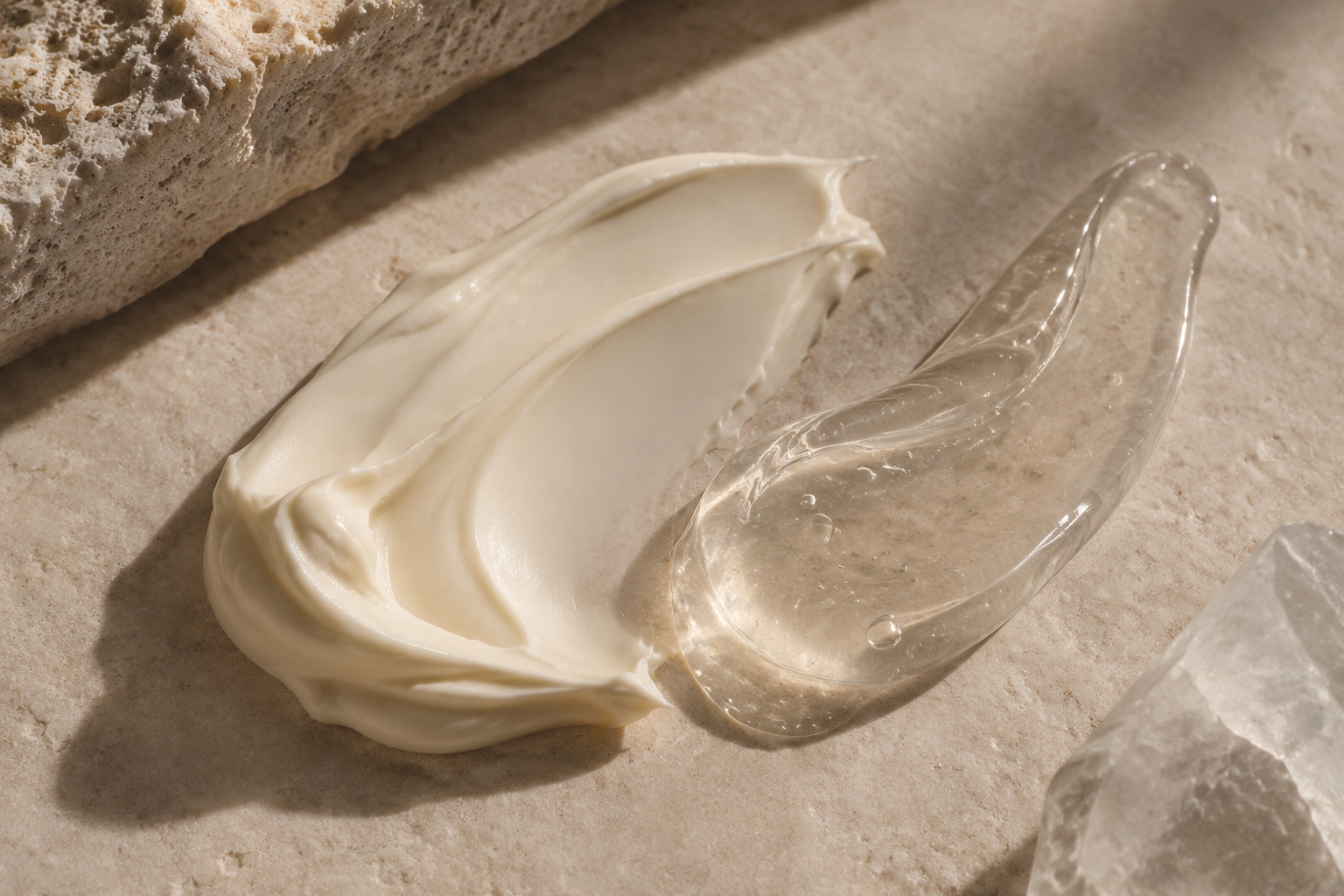
Healthy stratum corneum intercellular mortar comprises roughly 50% ceramides, 25% cholesterol, and 15% free fatty acids by weight, forming a tightly packed 3:1:1 molar orthorhombic lattice. Formulations that supply incomplete single-lipid ratios or alkaline pH (> 6.0) slow lamellar recovery and elevate transepidermal water loss (TEWL), whereas fragrance-free squalane-ceramide vehicles restore barrier cohesion.
1. The 3:1:1 Molar Ratio & Orthorhombic Packing
Using Peter Elias's brick-and-mortar model of the stratum corneum, terminally differentiated corneocytes form the proteinaceous bricks while multilayered lipid sheets fill the extracellular mortar. Unlike the phospholipid bilayers of living cell membranes, the stratum corneum mortar is almost devoid of phospholipids and instead arranges long-chain ceramides (especially Ceramide EOS, NP, and AP), free cholesterol, and saturated free fatty acids (C16-C26) into dense orthorhombic crystalline domains.
When topical cleansers, low-humidity winter air, or over-exfoliation deplete one lipid class, applying an unbalanced single lipid (such as pure petrolatum or cholesterol alone without ceramides) can temporarily occlude moisture but fails to accelerate physiological lamellar body secretion. Equimolar 1:1:1 mixtures or ceramide-dominant 3:1:1 ratios match native epidermal lipid assembly, accelerating TEWL normalization within hours of barrier perturbation.
2. Squalane vs. Plant Triglycerides: Oxidation & Fatty Acid Profiles
Plant-derived oils vary dramatically in their linoleic-to-oleic ratio and oxidative stability. In the archived Ampersand Restructure and Radiate vehicles, formulators favored fully saturated squalane paired with high-oleic/eicosenoic meadowfoam seed oil (Limnanthes alba), avocado oil, and shea butter unsaponifiables rather than unstable polyunsaturated oils prone to rancidity.
As detailed in pharmacological reviews of botanical skincare oils (Frontiers in Pharmacology, 2020), oils rich in linoleic acid (such as sunflower seed oil, Helianthus annuus) act as PPAR-alpha agonists that support endogenous ceramide synthesis, whereas excessive free oleic acid can fluidize stratum corneum lipid domains and increase permeability in already atopic skin.
| Lipid / Emollient | Chemical Class | Dominant Fatty / Chain Profile | Oxidative Stability | Barrier Function |
|---|---|---|---|---|
| Ceramide NP / EOS | Sphingolipid | Phytosphingosine + C18-C30 acyl chains | Very high | Structural lamellar sheet backbone |
| Phytosqualane | Saturated triterpene (C30H62) | Zero double bonds (hydrogenated olive/cane) | Highest (non-oxidizing) | Biomimetic sebum slip & TEWL seal |
| Limnanthes Alba (Meadowfoam) | Long-chain triglyceride | > 95% C20-C22 fatty acids (eicosenoic) | High | Slow-absorbing protective emollient film |
| Helianthus Annuus (Sunflower) | Linoleic triglyceride | ~60% Linoleic (C18:2), ~25% Oleic | Moderate (needs Tocopherol) | PPAR-alpha ceramide upregulation |
| Butyrospermum Parkii (Shea) | Stearic-oleic fat + triterpenes | ~42% Stearic, ~45% Oleic + lupeol esters | High | Semi-occlusive barrier shielding |
3. Why Fragrance-Free Architecture Matters for Compromised Skin
Contact dermatitis surveillance repeatedly places fragrance mix (especially oxidized limonene, linalool, geraniol, and eugenol hydroperoxides) among the top causes of cosmetic allergic contact dermatitis. Unlike primary irritants that cause immediate stinging, fragrance terpenes act as pro-haptens: upon air exposure in a dropper bottle, they autoxidize into reactive hydroperoxides that bind epidermal proteins and sensitize Langerhans cells.
Eliminating both synthetic parfum and volatile citrus or floral essential oils (bergamot, lavender, ylang-ylang) from leave-on barrier serums removes the single largest variable behind delayed erythema, perioral flares, and stinging during retinoid or acid acclimation. Note that trace botanical extracts such as rosemary leaf extract (Rosmarinus officinalis) used at < 0.05% for rosmarinic/carnosic antioxidant preservation of carrier oils behave very differently from high-terpene steam-distilled essential oils.
4. Aloe Polysaccharides, Acid Mantle Enzymes & Balm Cleansing
Lipids alone cannot hydrate dry corneocytes if the skin lacks free water to trap. Combining low-molecular humectants (glycerin, propanediol, sodium hyaluronate) with high-viscosity polysaccharides from organic Aloe barbadensis inner-leaf gel creates a moisture reservoir that softens keratin filaments before lipid emollients seal the surface.
Equally critical is enzymatic pH alignment during lipid processing. Two key extracellular enzymes that convert secreted glucosylceramides and sphingomyelin into mature barrier ceramides (beta-glucocerebrosidase and acid sphingomyelinase) exhibit peak catalytic activity near pH 4.5 to 5.0 and lose efficiency sharply above pH 6.5. Using alkaline bar soaps (pH 9.0-10.5) swells corneocytes, solubilizes cholesterol and fatty acids, and stalls enzymatic ceramide assembly for hours after rinsing.
Switching first-step makeup and UV-filter removal to a non-alkaline, lipid-continuous cleansing balm (such as the archived Resurface formula) followed by a pH-5.0 buffered serum keeps baseline transepidermal water loss near healthy 6-10 g/m2/h baselines instead of triggering post-wash tightness. For long-term lamellar resilience, combining endogenous ceramide precursors such as 2-5% niacinamide with topical phytosphingosine-backbone ceramides (Ceramide NP and ultra-long-chain acyl-ceramide EOS) bridges both acute surface occlusion and deeper keratinocyte lipid synthesis over a 28-day corneocyte turnover cycle.
In controlled human epidermal studies (Tanno et al., British Journal of Dermatology 2000), topical 2% niacinamide upregulated serine palmitoyltransferase activity, increasing de novo ceramide synthesis by 34% alongside free fatty acids and cholesterol, producing measurable TEWL reductions in dry and rosacea-prone skin within four weeks.
Historical Barrier & Cleanser Archive
Ceramide Biosynthesis & Dry Skin Barrier Essays
Preserves Ampersand's 2019 educational guides detailing how sphingolipids and niacinamide-driven ceramide synthesis reduce flaking, reinforce intercellular cohesion, and restore moisture retention in dry skin.
Fragrance-Free Standards for Sensitive & Redness-Prone Skin
Preserves the 2019 sensitivity manifesto explaining why all Ampersand ESD serums excluded added perfume and sensitizing essential oils to protect reactive barriers.
Aloe Barbadensis Polysaccharides as Humectant Base
Documents why organic aloe barbadensis extract replaced plain deionized water as the primary phase-one solvent across Ampersand's serum collection.
Restructure Barrier Moisturizer (Archived Product Monograph)
Historical archive entry for Ampersand's Restructure moisturizer, designed to seal water-based ESD serums with squalane, shea lipids, and barrier-compatible emollients.
Resurface Daily Cleansing Balm (Archived Product Monograph)
Historical archive entry for Ampersand's Resurface lipid-dissolving cleansing balm, formulated to remove sebum and UV filters without alkaline surfactant barrier disruption.